
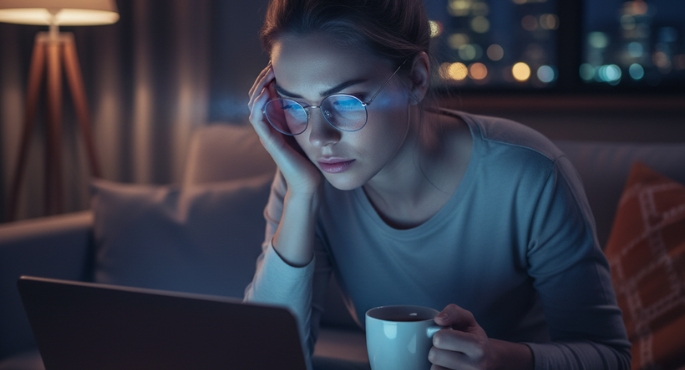
Introduction
Everyone has heard that screens are bad for your eyes. Parents worry about their children’s tablets. Office workers worry about their monitors. But the actual evidence on what screens do to eyes is more specific and more nuanced than most people realise. Some of the popular fears are not well supported. Some of the real effects are consistently underestimated. Understanding the difference helps you make better decisions about your eyes and your children’s.
The Real Problem Is Not the Screen, It Is the Blinking
The most documented effect of screen use on the eyes is reduced blink rate. Normal blink rate is around fifteen to twenty blinks per minute. During screen use, this drops to five to seven. Each blink refreshes the tear film on the eye surface. With fewer blinks, the eye surface dries out. This is the primary mechanism behind the fatigue, redness, burning, and blurred vision screen users experience. The symptoms are not caused by radiation or screen light but by the eye surface drying between infrequent blinks.
What Is Computer Vision Syndrome?
Computer vision syndrome (CVS), also called digital eye strain, is the collection of eye and vision problems that result from prolonged screen use. Symptoms include eye fatigue, headaches, blurred vision, dry and irritated eyes, neck and shoulder pain, and difficulty focusing after screen use. CVS affects an estimated fifty to ninety percent of regular screen users. It is not a disease and does not cause permanent damage to the eye. But it significantly affects comfort and productivity, and it accumulates with the number of screen hours per day.
What About Blue Light?
Blue light glasses have become popular with claims of protecting eye health. Current evidence does not support the idea that screen blue light causes significant eye damage. The intensity from screens is a fraction of natural daylight. The Cochrane Collaboration reviewed evidence in 2023 and found only low-quality support for blue light glasses reducing eye strain. The American Academy of Ophthalmology does not recommend them for eye protection. That said, blue light in the evening can suppress melatonin and affect sleep quality, which is a separate but valid concern.
What Screen Time Is Doing to Children’s Eyes
The most serious evidenced effect of screen time is its contribution to myopia progression in children. Children who spend more time indoors on screens develop myopia at higher rates and earlier ages. Children who spend at least two hours daily outdoors have significantly lower rates of myopia development. This is not about screens alone but the combination of near work and reduced outdoor time. Myopia in childhood is not just an inconvenience. High myopia increases lifetime risk of retinal detachment, glaucoma, and other serious eye conditions.
What Is Not Happening: Myths Worth Clearing Up
Screens do not cause permanent structural damage to the adult eye, cataracts, or retinal damage. Eye strain and fatigue from screens are real but reversible. Concern about screen use should be proportionate: it causes significant discomfort and accelerates myopia in children, but it does not destroy eyesight the way many fear-based articles suggest.
What You Can Actually Do
The 20-20-20 rule (every 20 minutes, look at something 20 feet away for 20 seconds) encourages blinking and reduces eye muscle fatigue. Adjust screen brightness to match ambient lighting. Increase text size to reduce focusing effort. Position screens slightly below eye level to slow tear evaporation. For children, prioritise at least two hours of outdoor time daily. If symptoms persist despite these changes, an eye evaluation will identify whether additional treatment is needed.
Consult Dr Rohit Bang at Shri Krishna Netralaya
If you or your child is experiencing persistent eye fatigue, headaches, or blurred vision after screen use, an eye examination will rule out underlying refractive problems and assess the eye surface. Dr Rohit Bang at Shri Krishna Netralaya, Chhatrapati Sambhajinagar, provides comprehensive eye care for adults and children.
Plot No. 50, Mahesh Nagar, Jalna Road, Chhatrapati Sambhajinagar, Maharashtra 431001
Call +91 9637268888 | Website: shrikrishnanetralaya.com
Conclusion
Screen time causes real eye effects, primarily through reduced blink rate, dry eye symptoms, and contribution to myopia in children. It does not cause permanent structural damage in adults and blue light from screens is not the primary concern. The most effective responses are behavioural: blink more consciously, take breaks, go outdoors, and get regular eye check-ups, particularly for children whose eyes are still developing.
FREQUENTLY ASKED QUESTIONS (FAQs)
Q1: Can screen time damage your eyes permanently?
In adults, current evidence does not support the idea that normal screen use causes permanent structural eye damage. Screen-related eye strain is real but reversible. The more serious concern is in children, where excessive screen time combined with limited outdoor time accelerates myopia development, which has long-term implications.
Q2: What is computer vision syndrome?
Computer vision syndrome (CVS) is the collection of eye and vision problems resulting from prolonged screen use: eye fatigue, headaches, blurred vision, dry eyes, and difficulty focusing. It affects most regular screen users and is caused primarily by reduced blink rate and sustained near-focus effort, not radiation from the screen.
Q3: Do blue light glasses actually protect your eyes?
Current evidence does not strongly support blue light glasses for preventing eye damage or significantly reducing eye strain from screens. The American Academy of Ophthalmology does not recommend them for eye protection. However, reducing blue light exposure in the evening can help with sleep quality, which is a separate benefit.
Q4: Why do my eyes feel tired after using a screen?
The main cause is reduced blink rate during screen use, which allows the eye surface to dry out and leads to fatigue, redness, and blurred vision. Sustained focus at a fixed near distance also fatigues the focusing muscles inside the eye. Both effects contribute to the tired feeling after prolonged screen sessions.
Q5: What is the 20-20-20 rule and does it work?
Every 20 minutes of screen use, look at something 20 feet away for 20 seconds. This encourages blinking, relaxes the focusing muscles, and allows the eye surface to recover. It consistently reduces digital eye strain when followed. Setting a timer helps until the habit becomes automatic.
Q6: Is screen time causing my child to become short-sighted?
Screen time contributes to myopia development in children primarily through the associated reduction in outdoor time rather than the screens themselves. Children who spend at least two hours daily outdoors have significantly lower rates of myopia development. Encouraging outdoor time is currently the most evidence-based intervention for slowing myopia progression in children.
Q7: What is myopia and why does it matter beyond needing glasses?
Myopia is short-sightedness: seeing clearly up close but not at distance. In children, it often progresses during school years. High myopia, where the prescription becomes very strong, increases lifetime risk of retinal detachment, glaucoma, and macular degeneration. This is why managing myopia progression early matters beyond just the inconvenience of glasses.
Q8: How should I position my screen to reduce eye strain?
Position the screen slightly below eye level, at arm’s length distance, and adjust brightness to match the ambient room lighting. Avoid screens in very dark rooms where the contrast between screen and surroundings is high. Larger text reduces the focusing effort required.
Q9: When should I see an eye doctor about screen-related symptoms?
See an eye specialist if symptoms including headaches, blurred vision, or eye fatigue persist despite taking breaks and adjusting screen habits, or if your child’s vision seems to be worsening. These symptoms can sometimes indicate an underlying refractive error that glasses or contact lenses would correct.
Q10: Where can I get an eye check-up for screen-related concerns in Aurangabad?
Dr Rohit Bang at Shri Krishna Netralaya, Plot No. 50, Mahesh Nagar, Jalna Road, Chhatrapati Sambhajinagar offers comprehensive eye examinations for adults and children. Call +91 9637268888 or visit shrikrishnanetralaya.com.